
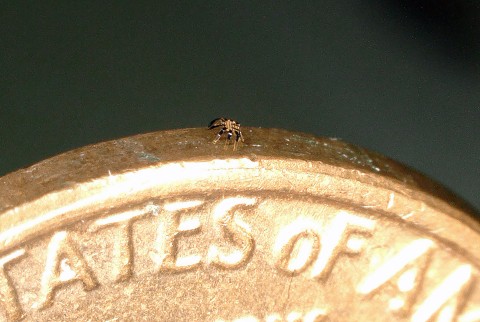
Engineers at Northwestern University have developed the smallest remote-controlled walking robot ever. It has the shape of a small and lovely crab.
A small crab with a width of only 0.5 mm can bend, twist, crawl, walk, bend and jump. Researchers have also developed millimeter-sized robots that resemble inchworms, crickets, and beetles. Research at this point is exploratory, but researchers believe their technology could bring the field closer to the realization of micro-sized robots that can perform practical tasks in tight spaces.
This study was published today (May 25) in the journal Science Robotics. Last September, the same team unveiled a winged microchip, the smallest artificial flight structure in history (on the cover of Nature).
“Robot engineering is an exciting field of research, and the development of microscale robots is a fun topic for academic research,” said John A. Rogers, who led the experimental work. “Microrobots are all minimally invasive procedures as agents for repairing or assembling small structures and machines in the industry, or as surgical assistants to clean blocked arteries, stop internal bleeding, and eliminate cancerous tumors. I can imagine it. ”
“Our technique allows for a variety of controlled motor modalities, allowing us to walk at an average speed of half the body length per second,” added Yonggang Huang, who led the theoretical study. “This is very difficult to achieve on a small scale like a ground robot.”
Rogers, a pioneer in bioelectronics, is Professor Lewis Simpson and Kimberly Kelly of Materials Science and Engineering, Biomedical Engineering and Neurosurgery at Northwestern University’s McCormick Engineering School and Fineberg School of Medicine, and the Kelly Simpson Institute for Bioelectronics (QSIB). Is the director of. Huang is a professor of mechanical engineering and civil engineering and environmental engineering at McCormick, Jan and Marcia Achenbach, and a key member of QSIB.
Crabs are smaller than fleas, so they are not powered by complex hardware, hydraulics, or electricity. Instead, that power is in the elastic elasticity of the body. To build a robot, researchers used shape memory alloy materials that transform into a “remembered” shape when heated. In this case, researchers used a scanned laser beam to rapidly heat the robot at various target locations throughout the robot’s body. The thin coating of glass elastically restores the corresponding part of the structure to its deformed shape as it cools.
When the robot changes from one phase to another (transforms into a memorized shape and returns again), the robot creates a move. The laser not only activates the robot by remote control, but also determines the walking direction of the robot by the scanning direction of the laser. For example, if you scan from left to right, the robot will move from right to left.
“These structures are so small that the cooling rate is very fast,” Rogers explained. “In fact, reducing the size of these robots will make them run faster.”
Rogers and Huang turned to the technique they introduced eight years ago to create such a small creature: a pop-up assembly method inspired by children’s pop-up books.
First, the team produced a precursor to a flat, planar walking club structure. These precursors were then glued to a slightly stretched rubber substrate. As the stretched substrate relaxes, a controlled buckling process occurs, causing the crab to “pop up” into a well-defined 3D shape.
This manufacturing method allowed the Northwestern University team to develop robots of various shapes and sizes. So why are crabs crabs? Thanks to Rogers and Huang students.
“These assembly techniques and material concepts allow us to build walking robots of almost any size or 3D shape,” Rogers said. “But the students were inspired and amused by the sideways crawling movements of the little crabs. It was a creative whim.”
Comments
Post a Comment